2026 Annual Research Forum: Student Winner
Qualitative Considerations on Personal Protective Equipment Use in Trauma Resuscitation 
First Author: Madison Bachler; Texas Tech University Health Sciences Center School of Medicine - Lubbock
Co-Authors: Andy Do, Carson Cooper, Conrad Bowman, MD, Jayne McCauley, MD, Amber Tucker, MSN, RN, CEN, and Stephanie Stroever, PhD, MPH
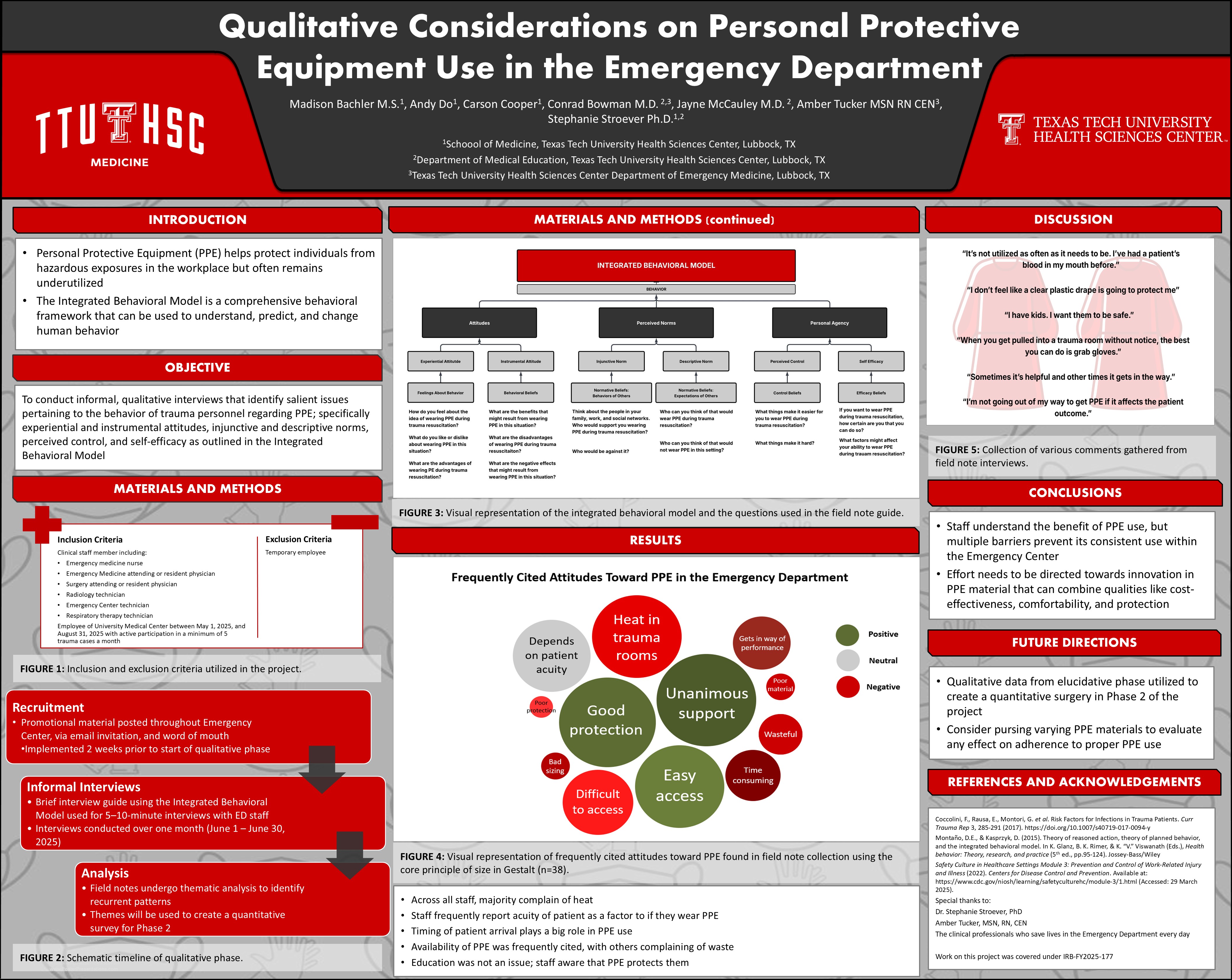
Background: Consistent use of personal protective equipment (PPE) is an evidence-based strategy to minimize hazard exposure and prevent infection in the workplace, yet adherence during trauma resuscitation remains suboptimal. The Integrated Behavioral Model (IBM) is a theoretical framework used to understand the factors that influence human behavior and to guide the development of interventions to promote behavior change. The model conceptualizes behavior into three key aspects – attitudes, perceived norms, and personal agency – that explain intention to perform a behavior. The objective of this study was to utilize the IBM to identify determinants of PPE use among personnel involved in trauma resuscitation at a Level I Trauma Center in West Texas.
Methods: Anonymous informal qualitative interviews informed by the IBM framework were conducted with trauma staff, including nurses, emergency medicine residents/attending physicians, surgical residents/attending physicians, emergency center (EC) technicians, and radiology technicians. Participants were recruited through promotional material posted in the EC, email invitation, and word of mouth over the course of a month. To be included, participants were required to be an employee of the Level I Trauma Center and an active participant in at least 5 trauma resuscitations in the past month. We performed a qualitative, thematic content analysis to identify key themes surrounding PPE use.
Results: We analyzed 38 informal qualitative interviews and found that despite low compliance, staff routinely mentioned the importance of PPE. A majority of team members specifically acknowledged the protective benefits of PPE. However, a majority also cited heat in the trauma rooms as an impediment to their PPE use. Further, staff reported that the plastic PPE available augmented the heat element, while others stated that the acuity and timing of patient arrival make donning PPE difficult.
Conclusions: This qualitative study elucidated the reasons for deciding whether to don PPE or not during trauma resuscitation using the IBM framework. A quantitative aspect of the study was designed and implemented to garner further data regarding the motivations behind these behaviors along with video review investigating PPE compliance in level I trauma cases. Further work on this mixed methods project will include an implementation phase to address behavioral and environmental barriers to PPE use and enhance compliance.
Acknowledgements: Texas Tech University Health Sciences Center Department of Emergency Medicine
|